6 Warning Signs Your Baby's Sleep Problem Isn't "Just a Phase" And How To Fix It

By Anna L. - Mom of 2.
Last Updated August 18, 2026


If you're reading this at 3AM with a little one in your arms, take a breath. You are not doing anything wrong.
More than 6 in 10 babies experience reflux or colic in their first year.
And most parents hear the same thing from their doctor: "It's normal. Just wait it out."
But what that advice rarely mentions is that there's often a biological reason behind the sleepless nights.
One that has nothing to do with your parenting — and everything to do with how your baby's body actually works.
The tricky part? It shows up differently for every baby.
See how many of these feel familiar.
Warning Sign #1:
They Only Sleep When Held Upright Against Your Chest
Warning Sign #1:
They Only Sleep When Held Upright Against Your Chest
The moment you put them down, they scream. But pressed against your chest, elevated and contained, they're calm within seconds.
That's not a coincidence. That position gives them exactly what their nervous system is craving — and what a flat bassinet can't provide.

The moment you put them down, they scream. But pressed against your chest, elevated and contained, they're calm within seconds.
That's not a coincidence. That position gives them exactly what their nervous system is craving — and what a flat bassinet can't provide.
Warning Sign #2:
They Wake Up Like Clockwork Every 45 Minutes
Warning Sign #2:
They Wake Up Like Clockwork Every 45 Minutes
You finally get them down. You tiptoe away. And exactly 45 minutes later — screaming.
Here's why: when your baby startles awake, their body releases a little burst of stress hormones.
And those hormones? They take about 45 minutes to clear.
So even when you soothe them back down... the clock is already running.
Their body isn't being difficult. It's just stuck in a loop.
And lying flat? It keeps hitting reset on that loop. Over and over again.

You finally get them down. You tiptoe away. And exactly 45 minutes later — screaming.
Here's why: when your baby startles awake, their body releases a little burst of stress hormones.
And those hormones? They take about 45 minutes to clear.
So even when you soothe them back down... the clock is already running.
Their body isn't being difficult. It's just stuck in a loop.
And lying flat? It keeps hitting reset on that loop. Over and over again.
Warning Sign #3:
Their Arms Shoot Out and They Startle Awake
Warning Sign #3:
Their Arms Shoot Out and They Startle Awake
One second, peaceful. The next — arms flinging, eyes wide, heart racing.
This is the Moro Reflex, sometimes called "The Baby Alarm."
Your baby's brain is still wired for the womb.
When they're lying flat and open, their nervous system thinks they're falling.
The alarm fires and sleep ends.

One second, peaceful. The next — arms flinging, eyes wide, heart racing.
This is the Moro Reflex, sometimes called "The Baby Alarm."
Your baby's brain is still wired for the womb.
When they're lying flat and open, their nervous system thinks they're falling.
The alarm fires and sleep ends.
Warning Sign #4:
They Arch Their Back and Scream After Feeds
Warning Sign #4:
They Arch Their Back and Scream After Feeds
That painful arch isn't drama. It's your baby trying to escape the burn.
Their esophagus muscle is still developing.
When they lie flat, stomach acid rises and burns their throat.
You can't always see it — that's why it's called "silent reflux" — but they feel every second of it.
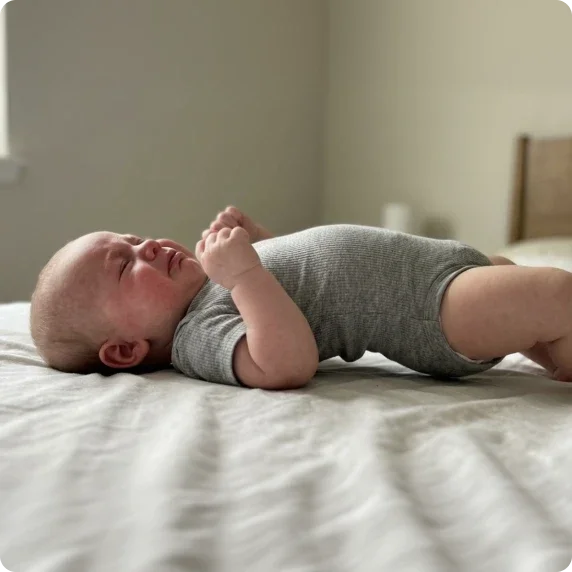
That painful arch isn't drama. It's your baby trying to escape the burn.
Their esophagus muscle is still developing.
When they lie flat, stomach acid rises and burns their throat.
You can't always see it — that's why it's called "silent reflux" — but they feel every second of it.
Warning Sign #5:
You've Tried Everything and Nothing Sticks
Warning Sign #5:
You've Tried Everything and Nothing Sticks
Gripe water. Gas drops. The $200 swing. White noise. Smaller feeds. The football hold.
Some things help for 20 minutes. Nothing actually fixes it.
That's because most solutions only address one piece of the problem — not the root cause.

Gripe water. Gas drops. The $200 swing. White noise. Smaller feeds. The football hold.
Some things help for 20 minutes. Nothing actually fixes it.
That's because most solutions only address one piece of the problem — not the root cause.
Recognizing your baby in 3 or more of these signs?
There's a reason — and a solution that's helped thousands of parents just like you.
Warning Sign #6:
You Can't Remember the Last Time You Slept More Than 2 Hours
Warning Sign #6:
You Can't Remember the Last Time You Slept More Than 2 Hours
Maybe the exhaustion has been so relentless, for so long... that a full night's sleep has started to feel like something that just isn't in the cards for you.
That quiet loss of hope in the middle of the night?
That's the part nobody talks about.

Maybe the exhaustion has been so relentless, for so long... that a full night's sleep has started to feel like something that just isn't in the cards for you.
That quiet loss of hope in the middle of the night?
That's the part nobody talks about.
The Hidden Cause Nobody's Talking About
The Hidden Cause Nobody's Talking About
All of these warning signs have one thing in common: lying flat makes them worse.
Flat = acid rises
Flat = gas gets trapped
Flat = no containment = The Baby Alarm fires
Your baby's nervous system is still expecting the womb — the warmth, the pressure, the constant "hug" on all sides.
A flat mattress is the opposite of that.
So their brain keeps sounding the alarm, flooding their body with stress hormones, and jolting them awake.
To break the cycle, you need two things: gentle incline AND full containment. Most products only offer one.

All of these warning signs have one thing in common: lying flat makes them worse.
Flat = acid rises
Flat = gas gets trapped
Flat = no containment = The Baby Alarm fires
Your baby's nervous system is still expecting the womb — the warmth, the pressure, the constant "hug" on all sides.
A flat mattress is the opposite of that.
So their brain keeps sounding the alarm, flooding their body with stress hormones, and jolting them awake.
To break the cycle, you need two things: gentle incline AND full containment. Most products only offer one.
The BabyBliss™ DreamNest: Designed To Make Your Baby Sleep For Hours
The BabyBliss™ DreamNest is the only sleep solution that combines the hospital-trusted 15° incline with a womb-like cocoon design — so it stops The Baby Alarm at the source.
Your baby doesn't just need a place to sleep. They need a place that actually feels safe to their little body.